
Acupressure Massage: What It Is and How It Works Explained
What Is Acupressure Massage and How Does It Work
Article Overview
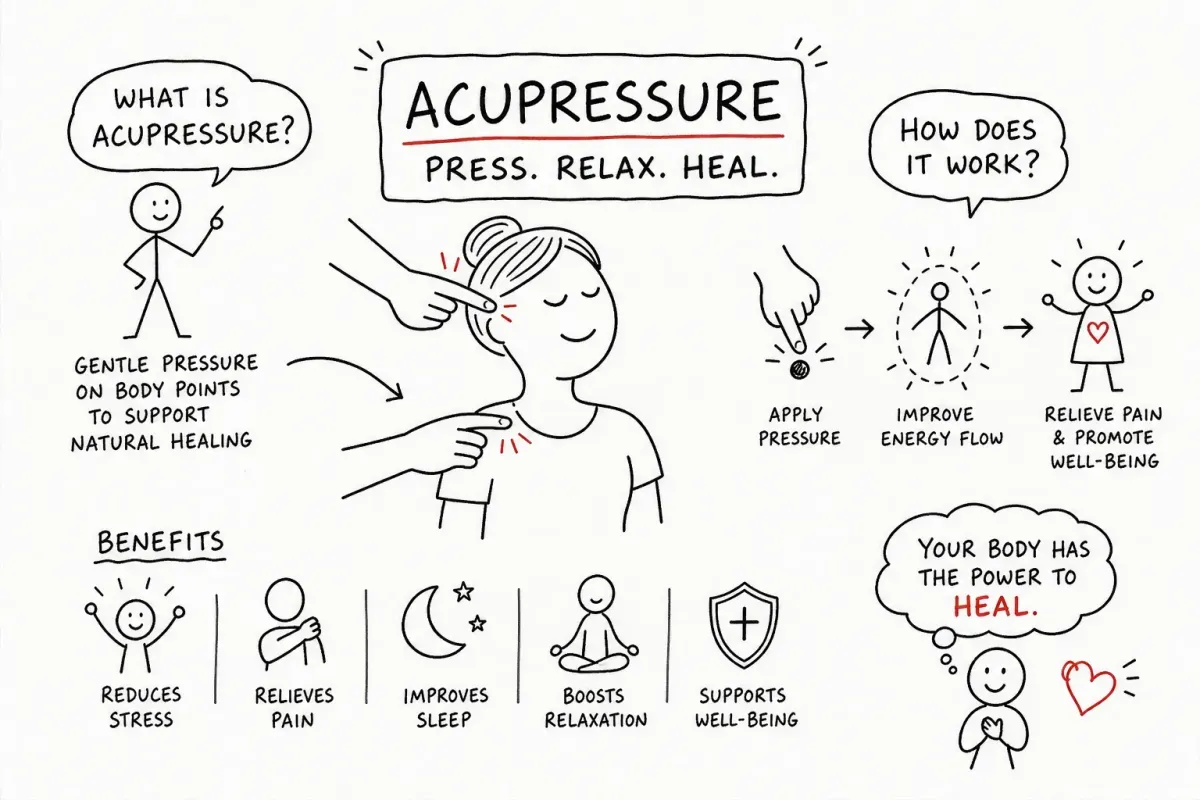
Acupressure massage is a needle-free form of Traditional East Asian Medicine (TEAM) that applies sustained pressure to acupoints—the same points used in acupuncture—to influence the nervous and meridian systems rather than treating muscle tissue. It can ease headaches, fatigue, and digestive complaints, is suitable for self-care, and may require a licensed TEAM practitioner for complex issues.
Most people think of healing bodywork as something that happens on a padded table, with low lighting and long, gliding strokes across tired muscles. That picture makes sense, it's the one most of us have experienced. But acupressure massage operates on a completely different premise. Rather than unknotting your shoulders, it works by communicating with your nervous system through specific points that practitioners have mapped, tested, and refined over thousands of years of clinical observation.
That distinction matters more than it sounds. Where conventional massage targets tissue, pressure-point therapy targets the body's internal communication network. The two approaches can complement each other, but they aren't doing the same thing. Understanding that difference is the starting point for anyone curious about Eastern bodywork, whether you're looking for a technique to try at home or considering working with a licensed Traditional East Asian Medicine practitioner.
This article covers what acupressure massage is, how it differs from Swedish massage, why location matters more than pressure, seven techniques you can practice at home, who needs to slow down before trying it, and when professional care is the smarter move.
What acupressure massage actually is
Acupressure massage is a needle-free form of Eastern bodywork that applies targeted pressure to specific points on the body, the same points used in acupuncture. It belongs to the system of Traditional East Asian Medicine (TEAM), which also includes moxibustion, Chinese herbal medicine, and qi gong. Chinese medical texts documented acupoint therapy thousands of years ago, making it one of the longest-practiced forms of therapeutic touch in recorded history.
Shiatsu is a well-known Japanese adaptation of pressure-point massage, and it's among the more familiar versions of this work for Western audiences. It shares the same meridian framework as classical Chinese acupressure but applies it with a more whole-body, sustained approach, using body weight to deliver still, deep pressure rather than point-specific stimulation. Both traditions share the same conceptual foundation: specific locations on the body serve as gateways to influencing internal systems. Acupressure vs. acupuncture is a common question at this stage, the core difference is simply the absence of needles, with the underlying point system remaining the same.
A session looks nothing like a Swedish massage. The client often stays clothed, with no oils, no broad strokes, and no draping. A practitioner commonly uses thumbs, fingers, palms, elbows, or specialized tools to apply sustained pressure or small circles at precise locations. Sessions commonly run 30 to 60 minutes, though format and length vary by practitioner and complaint. They typically address specific concerns, headache, fatigue, or digestive discomfort, alongside broader wellness goals. Self-acupressure applies the same logic at home, using your own hands.
How acupressure massage differs from Swedish massage
Swedish massage targets soft tissue: muscles, fascia, and connective tissue. The goal is to reduce physical tension, improve local circulation, and produce systemic relaxation through five signature strokes applied over broad surface areas. It is anatomical work. Acupressure massage targets points, not tissue. The goal is to stimulate specific locations that influence the body's internal energy pathways and organ systems. It is energetic and systemic work.
The way the hands move reflects that difference. Swedish strokes cover surface area. Acupressure uses sustained, still pressure or small circles at locations often no larger than a fingertip. The pressure in Swedish is generally progressive and releasing across a muscle. In pressure-point massage, the pressure is held at a single point, commonly for 30 to 60 seconds per application, long enough to generate a physiological response through the meridian system.
Neither approach is better. They are designed for different purposes. Swedish massage is an excellent tool for muscle recovery, stress-related tension, and general relaxation. Acupressure therapy is the right tool when the underlying pattern involves disrupted qi flow, organ system imbalance, or a symptom that keeps returning despite soft-tissue work. Knowing which one fits your situation is part of making smarter choices about your health. Reflexology, while related in its use of mapped points, focuses specifically on the feet and hands rather than the full meridian network.
The meridian system: why location matters more than pressure
In Traditional East Asian Medicine, qi (pronounced "chee") is the body's vital life energy. It moves through 12 primary pathways called meridians, each connected to a specific organ system and influencing physical, emotional, and mental health along its entire course. Disruptions or blockages in qi flow are understood as the root of pain, fatigue, and illness, not just symptoms to suppress.
Acupoints are specific locations along meridians where qi is most accessible and most responsive to stimulation. That's why pressing a point on your hand can ease a headache. The LI4 point, located in the web between your thumb and index finger, connects to the large intestine meridian, which travels through the neck and face. Pressing it is understood to move stagnant qi through the head and relieve pressure. The logic is systemic, not local.
Neurophysiological research, including fMRI studies and randomized controlled trials, offers a complementary explanation. Acupressure appears to activate sensory nerve fibers at specific points, triggering signals that travel to the spinal cord and brain. These signals engage the gate-control pain inhibition pathway and stimulate endogenous opioid release, including enkephalin and dynorphin. They also shift the autonomic nervous system toward parasympathetic activity and modulate the HPA axis to reduce cortisol output. These aren't competing explanations with the meridian model. They are two lenses pointing at the same observable outcome.
Seven acupressure massage techniques worth trying at home
These seven points address some of the most common complaints people bring to a TEAM practitioner. For each one, use firm but comfortable pressure, hold 30 to 60 seconds, and repeat two to three times daily. Stop immediately if you feel sharp or worsening pain.
For headaches and sinus pressure
1. LI4 (Hegu): Find the fleshy web between your thumb and index finger. Pinch the fingers together and press at the highest point of the muscle mound. Hold 30 to 60 seconds per side. This point is commonly used for tension headaches, sinus pressure, and facial pain by moving qi through the large intestine meridian's path through the head and face.
2. GB20 (Fengchi): Place both thumbs at the base of your skull and feel for the two hollows where the neck muscles meet the skull, just outside the spine. Press upward and inward. This point directly addresses tension at the back of the head and is widely used for tension and occipital headaches, though clinical trials on acupressure for headache show mixed results in terms of evidence quality. Adding one minute of slow nasal breathing while holding the point can deepen the calming effect.
3. Yintang (Third Eye): Place one finger at the midpoint between your eyebrows, in the small indentation above the bridge of the nose. Apply gentle, steady pressure. This point is particularly useful for stress-related and sinus headaches, and it also has a calming effect on the nervous system that extends well beyond headache relief, many people find it helpful as part of a brief wind-down routine before sleep.
For nausea and digestive upset
4. PC6 (Neiguan): Measure three finger-widths above the inner wrist crease, between the two tendons that run up the center of your forearm. Press straight in. This is the point targeted by acupressure wristbands sold for motion sickness, and it carries the strongest clinical evidence base of any acupressure point. Cochrane review-level evidence supports its use for postoperative nausea, pregnancy-related nausea, and chemotherapy-induced nausea.
For neck tension, lower back pain, and stress
5. GB21 (Jianjing): Find the top of your shoulder at the midpoint between your neck and the tip of your shoulder. Apply downward pressure with your opposite hand's fingers. This point is a reliable tool for neck and upper shoulder tension. Note: avoid this point during pregnancy, as it is traditionally contraindicated before 37 weeks due to its association with uterine stimulation.
6. BL23 (Shenshu): These points sit on either side of the lower spine at approximately waist level, about two finger-widths from the midline. They're difficult to reach with your own hands, so a tennis ball pressed against the wall and leaned into works well as a self-care tool. Hold the pressure for 30 to 60 seconds at a comfortable depth. If you tend to carry stress in the low back, this point is worth returning to daily.
7. LV3 (Taichong): Find the valley between the first and second toes on the top of your foot. Trace upward from the toe web until you feel a slight depression. Press firmly. This point is used for stress, anxiety, and headache support, and it pairs well with LI4 as a combination for moving qi throughout the body. Together, these two points, sometimes called the "Four Gates", are among the most commonly combined pairings in clinical TEAM practice.
Safety precautions and who should slow down
Self-acupressure is generally low-risk when applied gently on healthy skin, but several situations require more caution. Never apply pressure directly over open wounds, bruised tissue, inflamed skin, or any area with active infection. Deep sustained pressure is contraindicated over areas with known or suspected blood clots. Anyone taking blood thinners or anticoagulant medications faces elevated bruising risk and should keep pressure light and discuss the practice with their physician first. The same applies to anyone with a clotting disorder or significant cardiovascular history, a brief check-in with your doctor before starting is the right step.
People in active cancer treatment can often use acupressure complementarily, but clearing it with an oncologist first is essential, not optional.
Pregnancy requires specific attention. Acupressure is generally considered safe in uncomplicated pregnancies, but several points are traditionally avoided before 37 weeks because of their association with uterine stimulation. The most commonly cited include LI4, SP6, BL60, BL67, GB21, and points on the lower abdomen and sacral region. Anyone with a history of miscarriage, preterm labor, placenta previa, or pregnancy-related hypertension should consult a licensed TEAM practitioner or OB before using any acupressure at home. This isn't overcaution, it's the standard clinical approach that trained practitioners follow.
When self-care isn't enough: working with a TEAM practitioner
Self-acupressure is a legitimate daily practice. The seven points above address real problems, and several, particularly PC6, have meaningful clinical support. It's worth noting that evidence strength varies across conditions: nausea research is robust, while headache evidence remains more variable in quality. But self-care works on a single-point level, addressing the symptom in front of you. A licensed TEAM practitioner does something fundamentally different: they conduct a full diagnostic intake to identify the pattern behind your symptoms, not just the symptoms themselves.
That distinction is significant. Two people can both come in with chronic headaches and leave with entirely different treatment plans, because the underlying patterns driving those headaches are different. Point selection in a professional treatment reflects your constitution, your stress history, the time of year, and how multiple organ systems are interacting. No home guide can replicate that level of precision.
At Sjökort Health & Wellness in Kansas City, Dr. Holly Battrum holds a Doctorate in Acupuncture and Chinese Medicine (DACM) and brings a whole-person framework to every session, one that addresses the physical, emotional, and nervous system dimensions of health together. For anyone dealing with chronic pain, persistent fatigue, unresolved digestive issues, or burnout that doesn't respond to rest, an individualized TEAM treatment plan reaches into territory that pressure-point self-care can't access. Every program at Sjökort starts with your specific pattern, not a generic protocol, because that's the only way the work is actually useful.
Bringing it together
Acupressure massage isn't about relaxation as an end goal. It's about restoring communication between the body's systems, using a map that practitioners have refined for thousands of years and that modern neuroscience is now beginning to explain in its own language. Both frameworks point to the same conclusion: these points do something real.
The seven techniques in this article are a legitimate starting point. Use them. Notice what changes. That kind of direct, personal observation is how most people develop a genuine relationship with their own body's signals, and that awareness is worth more than any single technique.
Knowing when to take it further is part of taking your health seriously. If the same headache keeps returning, if the fatigue outlasts the sleep, if the stress response feels hardwired rather than situational, acupressure massage is a doorway into a broader system of care. For readers in Kansas City ready to walk through that door, Sjökort Health & Wellness is a strong place to start.
Q: What is acupressure massage and how does it work?
A: Acupressure massage is a needle-free form of Eastern bodywork that applies targeted pressure to specific points on the body—the same points used in acupuncture. It belongs to the system of Traditional East Asian Medicine (TEAM) and works by communicating with the nervous system and meridian pathways rather than by manipulating muscle tissue. Chinese medical texts documented acupoint therapy thousands of years ago, and practitioners use mapped points to influence internal systems and symptoms.
Q: How does acupressure differ from Swedish massage?
A: Swedish massage targets soft tissue (muscles, fascia, connective tissue) using long, gliding strokes to reduce tension and improve local circulation. Acupressure targets specific points to influence the body's energy pathways and organ systems, using sustained, still pressure or small circles often no larger than a fingertip. The two approaches can complement each other, but acupressure is energetic and systemic while Swedish massage is anatomical and surface-focused.
Q: Is acupressure the same as acupuncture?
A: They use the same underlying point system, but the core difference is that acupressure uses touch rather than needles. Acupressure delivers sustained pressure or small circular stimulation to acupoints, while acupuncture inserts needles at those points to achieve a therapeutic effect.
Q: What should I expect during an acupressure session?
A: Clients commonly remain clothed and sessions typically use no oils, no broad strokes, and no draping; practitioners apply pressure with thumbs, fingers, palms, elbows, or specialized tools. Pressure is applied precisely—often held for 30 to 60 seconds or delivered in small circles—and sessions commonly run 30 to 60 minutes, addressing specific concerns like headaches, fatigue, or digestive discomfort as well as broader wellness goals.
Q: Can I practice acupressure on myself at home?
A: Yes — self-acupressure follows the same logic as professional work, using your own hands to apply targeted pressure to acupoints. Use your thumbs or fingers to apply sustained pressure or small circles at precise locations and hold each point long enough (commonly 30 to 60 seconds) to generate a physiological response.
Q: Who should slow down or consult a professional before trying acupressure?
A: People with complex, serious, or uncertain medical conditions should consult a licensed Traditional East Asian Medicine (TEAM) practitioner or their healthcare provider before starting acupressure. Professional care is the smarter move when complaints are complicated, when you need a formal diagnosis, or when symptoms don’t respond to simple self-care.
Q: What are the main styles or traditions of acupressure I should know about?
A: Shiatsu is a well-known Japanese adaptation that uses the same meridian framework as classical Chinese acupressure but emphasizes whole-body, sustained pressure and body weight rather than point-specific stimulation. Acupressure more broadly is part of TEAM alongside practices like moxibustion, Chinese herbal medicine, and qi gong, and different traditions vary in touch, duration, and application while sharing the same conceptual foundation.


