
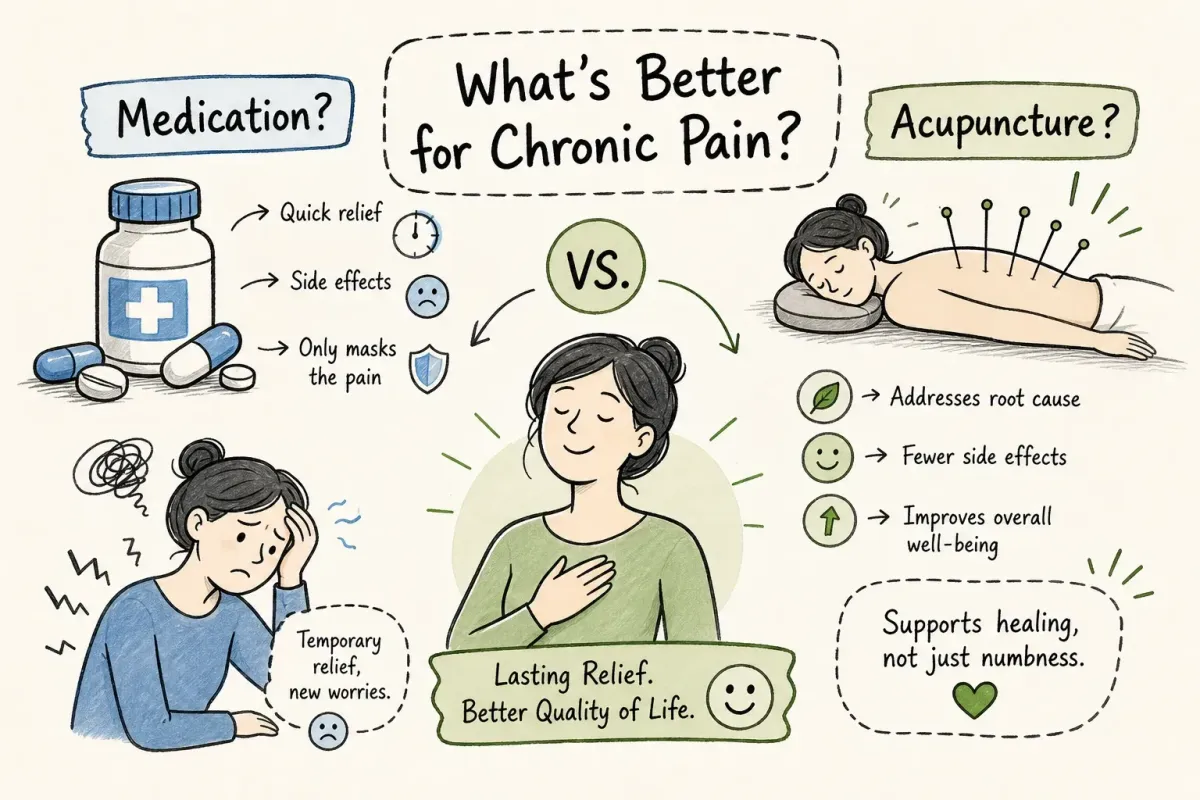
Acupuncture vs Medication: Chronic Pain Evidence Guide
Is acupuncture better than medication for chronic pain?
So, is acupuncture better than medication for chronic pain? At Sjökort Health & Wellness in Kansas City, clients often arrive holding a prescription in one hand and a referral for acupuncture in the other, yet still feel uncertain which path will bring lasting relief. What if neither alone is the full answer? What if acupuncture is only one tool in a larger system, one that extends "beyond the needle" into coaching, lifestyle guidance, and corporate wellbeing programs designed to address the root of chronic pain?
This article won't declare a simple winner. Instead, we'll show you how to think about acupuncture and medication as complementary tools within a comprehensive system of care. You'll learn what the research says, where evidence is strong or murky, and how to layer in coaching and wellbeing programs to build a sustainable plan that goes beyond needles or pills alone. Our goal is to equip you for a truly informed conversation with your care team, one that includes practitioners, coaches, and corporate wellbeing specialists working in concert.
How acupuncture and medication approach pain through completely different lenses
Most pain medications act at a biochemical level: NSAIDs block inflammatory prostaglandins, opioids bind central receptors to blunt pain perception, and gabapentinoids calm overactive nerve signals in neuropathy. Their effects are fast and measurable, but their side effects spread across multiple body systems.
Acupuncture works by stimulating endogenous opioids, modulating the autonomic nervous system, and damping central sensitization. Researchers debate how much of the benefit hinges on specific needle placement versus the therapeutic encounter as a whole. Either way, acupuncture's action is part of a broader framework: at Sjökort, we integrate it with coaching, teaching clients pain self-management, movement strategies, stress resilience, and corporate wellbeing practices that reinforce needle-based gains and help prevent recurrence.
Is acupuncture better than medication for chronic pain? Condition by condition
Chronic low back pain has the strongest acupuncture evidence. Cochrane reviews show moderate-certainty benefits for pain and function versus no treatment, and meaningful functional gains versus usual care. Against sham, effects shrink, highlighting the importance of nonspecific factors we address in our coaching programs, from goal setting to accountability. A 2025 Cochrane overview now supports acupuncture as a first-line option, a shift from its previous "last-resort" status.
For migraine and tension-type headache, NICE in the UK endorses acupuncture when drugs fail. Knee osteoarthritis trials sometimes favor acupuncture over NSAIDs, though certainty is low. Neck pain, shoulder pain, and fibromyalgia lack clear guideline support, precisely where a system of care "beyond the needle" can fill gaps by combining acupuncture with movement coaching, stress management, and ergonomic guidance.
Comparing effect sizes and risk profiles
Both acupuncture and NSAIDs show a standardized mean difference of about 0.2 against sham or placebo for musculoskeletal pain. Some meta-analyses in knee osteoarthritis even nudge in acupuncture's favor, though low certainty tempers enthusiasm. The key isn't a dramatic superiority, it's contrasting risk profiles. We leverage that difference in our corporate wellbeing programs, teaching teams how to integrate low-risk modalities like acupuncture and movement breaks instead of defaulting to medications with systemic risks.
Where opioids and antidepressants fit in
Opioids retain a role for acute severe pain but offer limited advantage, and high risk, for chronic management. Antidepressants for neuropathic pain show effect sizes of 0.3, 0.4; acupuncture averages around 0.5. Head-to-head trials are rare, but coaching and corporate programs can help patients taper medications safely by reinforcing self-management skills alongside needle-based interventions.
The safety question most people don't ask until it's too late
Serious adverse events with acupuncture occur in about 0.0005% of treatments; minor soreness or bruising in 7, 10%. In contrast, NSAIDs carry a 1, 4% annual risk of GI bleeding, opioids carry dependence and overdose risks, and gabapentinoids carry CNS side effects and withdrawal concerns. Our coaching framework helps clients weigh these long-term trajectories and incorporate nonpharmacologic pain-management strategies into daily routines.
What clinical guidelines recommend, and where they stay quiet
The American College of Physicians strongly recommends acupuncture as first-line nonpharmacologic care for chronic low back pain; the CDC endorses opioid-sparing approaches; Medicare covers up to 20 sessions per year. Yet NICE and the AAOS advise against acupuncture for osteoarthritis, and no major guideline endorses it for neck or shoulder pain. That's where clients benefit most from a system that combines acupuncture with coaching, movement education, stress resilience training, and corporate wellbeing initiatives.
Finding the right approach for your specific pain profile, beyond the needle
Acupuncture is a powerful tool, but not a standalone solution. At Sjökort, Dr. Holly Battrum and our team design a full system of care, integrating acupuncture, one-on-one coaching, group workshops, and corporate wellbeing programs to address posture, movement, stress, sleep, and mindset. For chronic low back pain, tension-type headache, or knee osteoarthritis, clients who combine regular acupuncture sessions with coaching report more durable relief, fewer flare-ups, and reduced reliance on medications.
If you're curious about how "beyond the needle" works in practice, bring your medication list, and your work context, to your first visit. We'll map out not just needles or prescriptions, but a customized roadmap: acupuncture protocols, individual coaching sessions, ergonomic assessments, mindfulness practice, and, if you're part of a team, a corporate wellbeing strategy that embeds these principles into your workplace culture.
So, is acupuncture better than medication for chronic pain?
It depends, but framing the question narrowly around needles versus pills misses the bigger picture. Acupuncture, when nested within a holistic system of coaching and corporate wellbeing, can outpace either medication alone or isolated needle sessions. For chronic low back pain, guidelines now endorse nonpharmacologic first steps; for other conditions, the evidence is mixed but always stronger when interventions are integrated. The real question is which combination of tools, supports, and programs makes the most sense for your long-term health. Let's talk beyond the needle, and build the system that moves you from temporary relief to lasting resilience.
Frequently asked questions
Is acupuncture better than medication for chronic pain in general?
Not universally, but for specific conditions, particularly chronic low back pain, acupuncture is now recommended as a first-line nonpharmacologic option by the American College of Physicians. The evidence is strongest there. For other conditions like knee osteoarthritis or tension-type headache, the research is more mixed, and the right choice depends on your medical history, risk factors, and treatment goals. Comparing acupuncture vs. medication for chronic pain is less about finding a single winner and more about matching the right approach to the right patient.
Can acupuncture and medication be used together?
Yes, and research suggests that combination approaches often outperform either treatment used alone. Many patients at Sjökort Health & Wellness use acupuncture alongside conventional care, sometimes with the goal of gradually reducing their reliance on NSAIDs or opioids over time. Always coordinate with your prescribing physician before making changes to your medication regimen.
Is acupuncture covered by insurance for chronic pain?
Medicare now covers up to 20 acupuncture sessions per year specifically for chronic low back pain. Private insurance coverage varies widely by plan and condition. It's worth calling your insurer before starting treatment to understand what's covered and what documentation may be required.
What are the risks of acupuncture compared to long-term NSAID use?
Acupuncture's serious adverse event rate is approximately 0.0005% per treatment when performed by a licensed practitioner, far lower than the 1 to 4% annual rate of serious gastrointestinal bleeding associated with long-term NSAID use. Minor side effects like temporary soreness or bruising occur in roughly 7 to 10% of patients. For patients with cardiovascular, renal, or GI risk factors, this safety difference is a meaningful part of the treatment decision.


