
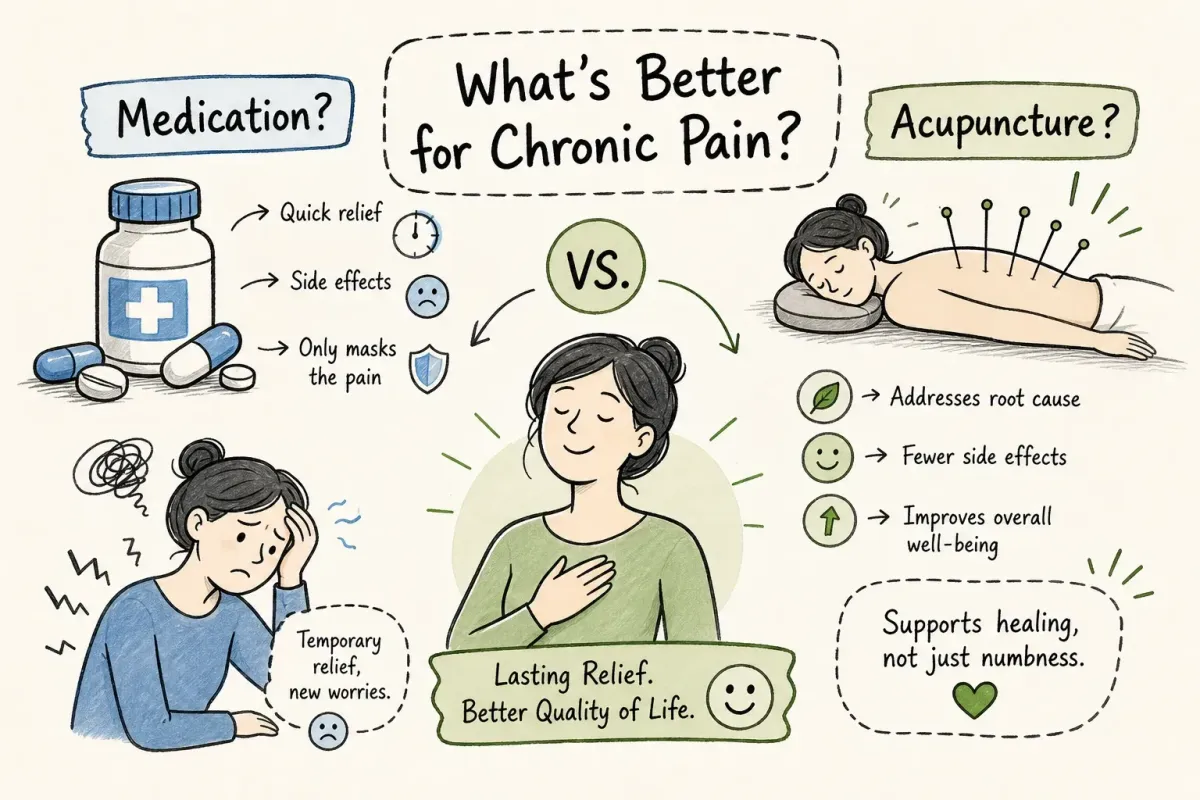
Acupuncture vs Medication: Chronic Pain Evidence Guide
Is acupuncture better than medication for chronic pain?
So, is acupuncture better than medication for chronic pain? It's one of the most common questions new clients bring to Sjökort Health & Wellness in Kansas City, and it deserves a more thoughtful answer than a shrug. Picture this: you're sitting in your doctor's office with a prescription for naproxen in one hand and a referral to an acupuncturist in the other. Your doctor says, "It's worth trying." You leave with no real sense of which one will help, whether they can be used together, or what the research shows.
This article doesn't hand you a simple winner. The honest answer is that it depends on the condition, the person, and what "better" means for your goals. What I can do is walk you through what the research shows, where it's solid, where it gets genuinely murky, and how to think through the choice for your specific situation. The goal is to leave you equipped for a real conversation with your care team.
How acupuncture and medication approach pain through completely different lenses
Most pain medications work by interrupting the pain signaling chain at a biochemical level. NSAIDs block the prostaglandins that cause inflammation; opioids bind directly to receptors in the brain and spinal cord to blunt pain perception; gabapentinoids calm overactive nerve signaling in conditions like neuropathy. These mechanisms are fast and measurable, which is part of why conventional medicine defaulted to them. The trade-off is that they interact with systems well beyond the pain pathway, and that's exactly where most of the side effects originate.
Acupuncture's mechanism is less intuitive but not mysterious. Research shows it stimulates the release of endogenous opioids (the body's own pain-dampening chemicals), modulates the autonomic nervous system, and reduces central sensitization, the process by which the nervous system amplifies pain signals over time. There's genuine scientific debate about whether specific needle placement matters or whether much of the benefit comes from the broader therapeutic encounter. That debate is worth acknowledging honestly, because it shapes how we interpret the clinical data.
Is acupuncture better than medication for chronic pain? What the evidence shows, condition by condition
Chronic low back pain has the deepest evidence base for acupuncture. Cochrane reviews consistently find that acupuncture outperforms no treatment with moderate certainty for both pain and function. Against usual care, it improves function meaningfully. The more contested finding is against sham acupuncture: the difference exists but often isn't clinically significant, which suggests nonspecific effects play a role. A 2025 Cochrane overview went further, supporting acupuncture as a reasonable first-line option for chronic low back pain based on the combination of moderate efficacy and very low harm. That's a notable shift from a decade ago, when it was treated as a last resort.
For chronic headache and migraine, NICE in the UK endorses acupuncture when pharmacological options have failed, citing genuine evidence of benefit. For knee osteoarthritis, some network meta-analyses show acupuncture performing comparably or even favorably against NSAIDs, though certainty ratings are low, and that finding warrants shared decision-making rather than a blanket recommendation. For neck pain, shoulder pain, and fibromyalgia, the picture is genuinely unclear: no major guideline currently recommends acupuncture for these conditions. Knowing which conditions have evidence behind them prevents spending time and money on treatments unlikely to help, and that honesty matters.
Acupuncture vs. medication for chronic pain: comparing effect sizes
When you look at effect sizes against control conditions, acupuncture and NSAIDs come out surprisingly similar for musculoskeletal chronic pain. Both show a standardized mean difference of roughly 0.2 against their respective controls (sham and placebo). Some meta-analyses for knee osteoarthritis show acupuncture performing better than NSAIDs directly, though those findings carry very low certainty ratings and shouldn't be overstated. The meaningful takeaway is not that acupuncture is dramatically superior, but that for equivalent pain relief, it carries a meaningfully different risk profile. That's the real clinical argument for considering it.
Where opioids and antidepressants fit in
Opioids produce larger effect sizes for acute severe pain, which is where they still have a legitimate role. For chronic pain management, their advantage narrows considerably while their risk profile escalates. Antidepressants used for neuropathic pain, like duloxetine or amitriptyline, typically show effect sizes of 0.3 to 0.4; acupuncture's average effect size across chronic pain conditions broadly sits around 0.5, though the populations studied differ. Direct head-to-head trials between acupuncture and antidepressants are scarce, so this comparison is indirect. But the pattern across independent meta-analyses is consistent enough to be informative. That said, comparable numbers tell only part of the story.
The safety question most people don't think to ask until it's too late
Acupuncture's serious adverse event rate sits at approximately 0.0005% per treatment. Minor events like bruising, mild soreness, or temporary dizziness occur in roughly 7 to 10% of patients. For context, serious adverse events, things like pneumothorax or infection from improper needling technique, are extraordinarily rare when treatment is delivered by a licensed practitioner. Per-treatment, acupuncture's serious adverse event rate is orders of magnitude lower than the per-patient risks associated with long-term NSAID or opioid therapy.
The contrast with long-term medication use is significant. NSAIDs carry a 1 to 4% annual rate of serious gastrointestinal bleeding, and research suggests that up to 70% of chronic users develop endoscopic abnormalities without reporting symptoms first, though rates vary by NSAID type, dose, duration, patient age, and co-medications. Opioids are associated with dependence in 8 to 12% of chronic users, with overdose risk that compounds over years. Gabapentinoids carry CNS side effects, documented withdrawal risks, and an elevated risk of suicidal ideation that has become more clearly recognized in recent years. These aren't arguments against medications when they're needed. They're arguments for understanding what the risk-benefit equation looks like over a treatment course of months or years, not just a single prescription.
What clinical guidelines recommend, and where they stay quiet
The American College of Physicians issued a strong recommendation for acupuncture as a first-line nonpharmacologic treatment for chronic low back pain, before medications are considered. The CDC references nonpharmacologic approaches explicitly in opioid-sparing guidance. Medicare now covers up to 20 acupuncture sessions per year for chronic low back pain. When the largest health insurance program in the country covers a treatment, calling it "alternative" no longer captures what it is.
But here's where it's important not to overstate things. NICE and the American Academy of Orthopedic Surgeons both advise against acupuncture for osteoarthritis. No major guideline currently recommends it for neck or shoulder pain. For fibromyalgia, evidence is insufficient for a formal recommendation in any direction. Well-meaning practitioners sometimes overreach on acupuncture's evidence base, and patients deserve an accurate map of where the support is strong and where the jury is still genuinely out. That clarity is what makes informed decisions possible.
Finding the right approach for your specific pain profile
For chronic low back pain, and for knee pain or tension-type headache in patients where NSAID side effects are a real concern due to cardiovascular risk, renal issues, or GI history, acupuncture has evidence behind it that warrants a conversation about starting there, particularly through shared decision-making with your provider. The strength of that evidence is highest for chronic low back pain; for knee osteoarthritis and tension-type headache, certainty is lower and individual factors matter more. This consideration is especially relevant for patients who want to avoid the dependency risks associated with opioid therapy or the cognitive side effects associated with gabapentinoids. A course of 6 to 12 sessions can represent a cost profile comparable to several months of prescription expenses, depending on your location, insurance coverage, and specific medications involved, and the safety difference shifts the risk-benefit math considerably.
Some conditions and pain profiles don't respond optimally to either acupuncture or medication in isolation. Research on combination therapy suggests that acupuncture alongside conventional care can outperform either approach used alone, with the added benefit of reducing opioid and NSAID use over time. At Sjökort Health & Wellness, Dr. Holly Battrum approaches each client's pain profile as its own clinical puzzle, evaluating whether acupuncture, an integrative combination strategy, or close collaboration with the client's prescribing physician offers the clearest path forward. That individualized evaluation is where care becomes genuinely useful rather than generically applied.
If you're considering acupuncture, bring your current medication list to your first appointment and ask your practitioner how they communicate with conventional providers. That single question opens the door to coordinated care, and coordinated care means your acupuncturist and your prescribing physician are working from the same picture of your health, not conducting two parallel conversations in separate rooms. That kind of collaboration is often what separates a treatment that helps from one that just adds another appointment to your calendar.
So, is acupuncture better than medication for chronic pain?
Whether acupuncture outperforms medication for chronic pain depends on the condition, the person, and what "better" means for that individual's goals and risk tolerance. For chronic low back pain, the evidence is strong enough that guidelines now recommend trying nonpharmacologic options, including acupuncture, before reaching for the prescription pad. For other conditions, the picture is more nuanced, and some don't have enough evidence to support acupuncture at all.
What is consistent across most conditions studied is that acupuncture's per-treatment serious adverse event rate is substantially lower than the per-patient risks of long-term medication use, and that matters when chronic pain is measured in years, not weeks. The question worth asking isn't which approach wins. It's which approach, or which combination, makes the most sense for your body, your history, and your long-term health. Bring that question to a practitioner who takes the time to work through it with you.
Frequently asked questions
Is acupuncture better than medication for chronic pain in general?
Not universally, but for specific conditions, particularly chronic low back pain, acupuncture is now recommended as a first-line nonpharmacologic option by the American College of Physicians. The evidence is strongest there. For other conditions like knee osteoarthritis or tension-type headache, the research is more mixed, and the right choice depends on your medical history, risk factors, and treatment goals. Comparing acupuncture vs. medication for chronic pain is less about finding a single winner and more about matching the right approach to the right patient.
Can acupuncture and medication be used together?
Yes, and research suggests that combination approaches often outperform either treatment used alone. Many patients at Sjökort Health & Wellness use acupuncture alongside conventional care, sometimes with the goal of gradually reducing their reliance on NSAIDs or opioids over time. Always coordinate with your prescribing physician before making changes to your medication regimen.
Is acupuncture covered by insurance for chronic pain?
Medicare now covers up to 20 acupuncture sessions per year specifically for chronic low back pain. Private insurance coverage varies widely by plan and condition. It's worth calling your insurer before starting treatment to understand what's covered and what documentation may be required.
What are the risks of acupuncture compared to long-term NSAID use?
Acupuncture's serious adverse event rate is approximately 0.0005% per treatment when performed by a licensed practitioner, far lower than the 1 to 4% annual rate of serious gastrointestinal bleeding associated with long-term NSAID use. Minor side effects like temporary soreness or bruising occur in roughly 7 to 10% of patients. For patients with cardiovascular, renal, or GI risk factors, this safety difference is a meaningful part of the treatment decision.


