
Nervous System Regulation at Work: Pro's Practical Guide
Nervous System Regulation at Work: A Pro's Guide
Nervous system regulation at work is one of the most overlooked performance factors for high achievers, because the most composed person in the room is often the most dysregulated. High achievers learn early to look fine, perform fine, and push through. The nervous system adapts. What started as a response to one stressful quarter becomes the operating system. Chronic sympathetic activation stops feeling like stress and starts feeling like baseline.
There's a real irony here: the harder you work, the better your body gets at sustaining a threat state, and the less it signals that anything is wrong. Burnout rarely announces itself. It accumulates quietly behind productivity numbers and full calendars. By the time most professionals recognize it, the nervous system has been running on stress adaptation for months.
This guide covers specific, discreet techniques for keeping your nervous system regulated during the workday, nothing that requires a meditation room, a yoga mat, or explaining yourself to a coworker. The techniques take between 30 seconds and 5 minutes. Some work during a meeting. If you're in Kansas City and these tools help but don't fully resolve what you're experiencing, Sjökort Health & Wellness works specifically with high-performers who need more than a breathing exercise.
What it actually looks like when your nervous system is dysregulated at work
The symptoms high-performers explain away
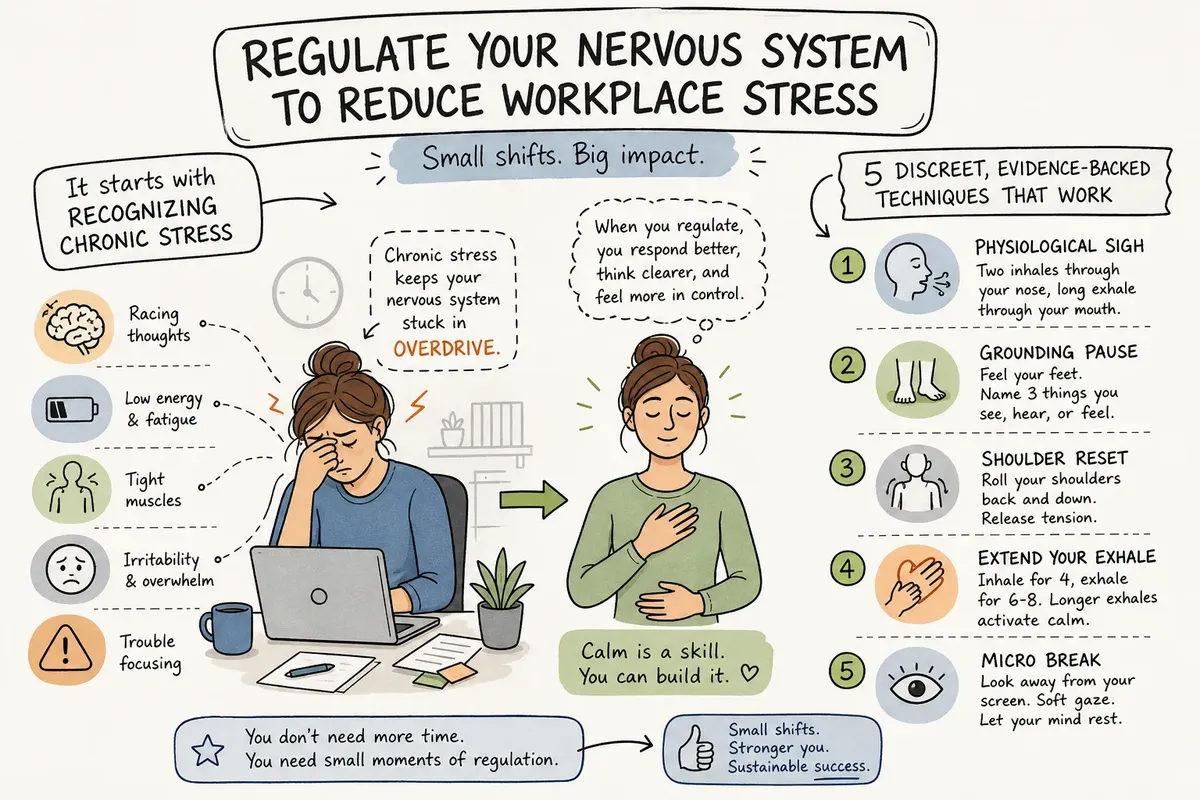
You know the feeling: jaw clenching through a meeting you don't need to be in, shallow breathing you don't notice until you exhale for the first time in an hour. There's an inability to focus after back-to-back calls, not because the calls were hard, but because switching contexts has become genuinely difficult. Snapping at something minor: a slow app, a misread tone in an email, a coworker asking the wrong question at the wrong moment.
These aren't personality traits. They are the autonomic nervous system stuck in sympathetic overdrive. The body is responding to a threat it can't outrun because the threat is the inbox, the deadline, the performance review. The afternoon energy crash has multiple causes, circadian rhythms, meal timing, sustained sympathetic activation, and sleep quality all play a role. Feeling "on" at 10 p.m., hours after logging off, is not ambition. It's a nervous system that doesn't know how to downshift.
Why chronic stress becomes your new normal
The nervous system adapts to repeated activation. An acute stress response that fires regularly becomes a habitual baseline. The body stops signaling distress because it no longer registers the state as abnormal. This is why so many high-achievers describe burnout as coming out of nowhere: they were dysregulated for months, sometimes years, before it registered as a problem.
Recognizing the pattern is the first act of regulation. Before you can shift your nervous system, you have to notice where it is. That awareness alone changes something. What does that look like practically? It's catching yourself holding your breath at your desk, or noticing that your shoulders have been up around your ears since the 9 a.m. call.
Breathwork for nervous system regulation at work (under 5 minutes)
The breathing pattern that changes your heart rate variability
The most consistently supported short practice is slow diaphragmatic breathing at roughly 5 to 6 breaths per minute. Multiple peer-reviewed studies on resonance breathing (inhale 5 seconds, exhale 5 seconds) and the long-exhale method (inhale 4 seconds, exhale 6 seconds), including work published in Applied Psychophysiology and Biofeedback, show that both increase vagally mediated heart rate variability and support the parasympathetic response. Five minutes is enough for a measurable shift in perceived stress.
The mechanism is straightforward: a longer exhale signals safety to the brain's threat-detection system. Heart rate tends to rise slightly on the inhale and slow on the exhale. When you extend the exhale, you're giving your nervous system a direct input, the threat is not immediate. You don't need to understand the neuroscience for it to work. You just need to breathe more slowly than you currently are. If you feel lightheaded or notice any chest discomfort, return to your normal breathing pace.
Keeping breathwork invisible in an open office
Most people assume breathwork requires closing your eyes or announcing yourself. It doesn't. Breathwork for workplace stress can happen silently during a meeting, at your desk, or between emails. The breath stays diaphragmatic and quiet, not dramatic. Sit upright, feet on the floor, hands loose. Inhale through the nose, exhale slowly. No one around you needs to know, and there's nothing to see.
Grounding techniques for nervous system regulation at work
Three discreet techniques that redirect the nervous system
Sensory grounding works by redirecting the brain's attention from internal threat signals to present-moment sensory data. When the nervous system detects genuinely new sensory information, the threat response quiets. Three practices are especially practical in an office setting:
Feet-and-chair grounding: Press both feet firmly into the floor for 5 to 10 seconds, release, and notice pressure and temperature. Pair with a slow exhale. This is completely invisible and takes under 30 seconds.
3-3-3 sensory reset: Silently name three things you see, three sounds, and three physical sensations. For example: the edge of your monitor, a plant, the window frame. The hum of your keyboard, HVAC noise, distant voices. Feet in your shoes, the chair against your back, hands resting on the desk. Under 90 seconds, and it works during a call.
Contact-point scan: Move attention through feet, legs, pelvis, back, hands, jaw, and shoulders. Label sensations as pressure, warmth, or tension. Don't try to fix them. Simply notice for 60 to 90 seconds.
Why sensory grounding works on the autonomic nervous system
Drawing on the polyvagal framework, a useful clinical model, though some of its specific neurophysiological claims are still being refined by researchers, the nervous system tends to calm when it detects present-moment safety rather than imagined future threat. Naming what is actually here, not what might happen in the meeting this afternoon, likely reduces threat appraisal and supports vagal regulation through the body's natural orienting response. When something genuinely novel is noticed, the threat response quiets. It's not a trick. It's how the nervous system is designed to work.
Up-regulation vs. down-regulation: reading what your body actually needs
How to diagnose your state before choosing a tool
The most common mistake in nervous system regulation at work is applying one strategy regardless of current state. Breathwork when you're already flat and foggy will not help you. Certain movements when you're already overstimulated can make it worse. There are two directions: up-regulation raises energy and alertness; down-regulation lowers excessive arousal. Reading which one you need is the skill.
Fatigue, disengagement, and mental flatness signal under-arousal. Racing thoughts, irritability, a tight chest, or the sensation of bracing for impact signal over-arousal. The tool you reach for should match the state, not the time of day.
A simple map for the workday
A practical rhythm looks like this: up-regulate at the start of the day if you're sluggish, using movement, bright light, or an engaging first task. Down-regulate after a difficult meeting or conflict before switching to focused work, so the stress from one context doesn't bleed into the next. Up-regulate again during the midafternoon dip with a short walk or a change of scene. Down-regulate intentionally at the end of the workday to genuinely exit work mode, not just change locations.
The goal is regulatory flexibility: the ability to raise activation when under-aroused and lower it when over-aroused. This is different from chasing maximum energy or total calm. Calm alertness is the target.
Micro-routines and boundary-setting that protect your nervous system baseline
The case for 2-minute movement breaks every 30 to 60 minutes
Research on microbreaks reliably shows improvements in perceived vigor and fatigue reduction, subjective benefits that are well-supported across studies. Evidence for consistent changes in physiological stress markers like cortisol is more mixed, but the case for protecting attention and reducing cumulative sympathetic activation through brief interruptions is strong. A 2 to 3 minute walk, shoulder rolls, or looking away from the screen every 30 to 60 minutes is enough to interrupt stress accumulation without disrupting workflow. You don't need to meditate. You need to briefly stop.
Transition rituals as nervous system anchors
Between tasks or meetings, a micro-ritual creates a physiological reset rather than letting the emotional residue of one context carry into the next. A slow breath before picking up the next item. A 3-3-3 reset after a difficult call. Stepping outside briefly. These are small practices with a specific function: they prevent stress stacking, where the arousal from one meeting compounds into the next and carries through the afternoon.
Workplace conditions that make regulation harder
Boundary-setting is also nervous system regulation. Constant notifications, back-to-back meetings, no quiet space, and no control over sensory input are not neutral inconveniences. They are sustained physiological stressors. Protecting transition time between meetings, reducing meeting density where possible, and managing sensory load are not soft preferences. They are practical requirements for a nervous system that can regulate itself.
When daily techniques aren't enough: the case for a deeper reset
Signs that self-regulation tools have hit their ceiling
There's a point where breathwork and grounding become maintenance, not treatment. If dysregulation is chronic, sleep is consistently disrupted, anxiety feels like baseline rather than situational, or the body no longer responds to regulation techniques, something deeper is happening. The nervous system isn't just stressed, it has adapted to a sustained threat state, and daily tools alone can't fully address that adaptation. Clinically, this pattern is sometimes described as dysautonomia or persistent autonomic dysfunction, and it warrants evaluation beyond self-guided tools.
The body doesn't always give clear signals at this stage. That "wired but tired" feeling, the inability to relax even when nothing is wrong, or the complete absence of appetite for things that used to matter, these are data points worth taking seriously.
How acupuncture and vagus nerve toning support what breathwork alone can't
Acupuncture has documented effects on vagal tone, cortisol, and heart rate variability. Randomized controlled trials have found modest, short-term improvements in autonomic balance and perceived stress in adults experiencing chronic activation, though researchers note variability in sample sizes and study designs, and larger trials are ongoing. Vagus nerve toning practices, combined with interoceptive awareness work, may support nervous system regulation at a deeper level than moment-to-moment symptom management.
At Sjökort Health & Wellness in Kansas City, Dr. Holly Battrum works specifically with high-achieving professionals whose bodies have been running on stress adaptation for years. The approach is integrative and individualized, not a generic program, but a whole-person reset built around your actual nervous system, your history, and your life. Self-regulation tools are a starting point. A personalized clinical program offers a different level of support.
The real goal isn't calm, it's flexibility
Regulating your nervous system at work isn't about achieving perfect calm or eliminating stress from your job. Stress is information. The problem is getting locked in a chronic activation loop where the signal never turns off and the body forgets what baseline feels like.
The workplace nervous system regulation techniques in this guide are discreet, short, and grounded in current evidence. Pick two or three to experiment with this week. Don't overhaul everything at once. Notice what shifts, even slightly, and build from there.
If these tools help but don't fully land, that's useful information, it means the dysregulation runs deeper than a daily practice can address on its own. Finding the right integrative practitioner is a reasonable next step, not a last resort.
Frequently asked questions about nervous system regulation at work
How can I practice nervous system regulation at work during a meeting?
The most meeting-friendly options are feet-and-chair grounding and slow diaphragmatic breathing. Both are completely invisible, require no equipment, and take under 60 seconds. Press your feet into the floor and extend your exhale slightly longer than your inhale. No one in the room will notice, and the shift in your physiology is real.
What are the signs I need more than stress regulation at work tools?
If your sleep is consistently disrupted, you feel anxious or "wired" even during downtime, or standard breathwork and grounding no longer seem to touch your stress response, those are signs the dysregulation has become chronic. At that point, a clinical evaluation, including review of orthostatic symptoms, sleep, and autonomic function, is a reasonable and practical next step.
How quickly does nervous system regulation at work produce results?
Breathwork at 5 to 6 breaths per minute can produce measurable changes in heart rate variability within 5 minutes. Subjective shifts in perceived stress are often noticeable within one to two sessions of consistent practice. Structural change, training the nervous system to return to baseline more easily, takes repeated practice over weeks, and for chronically dysregulated systems, clinical support typically accelerates the process.


