
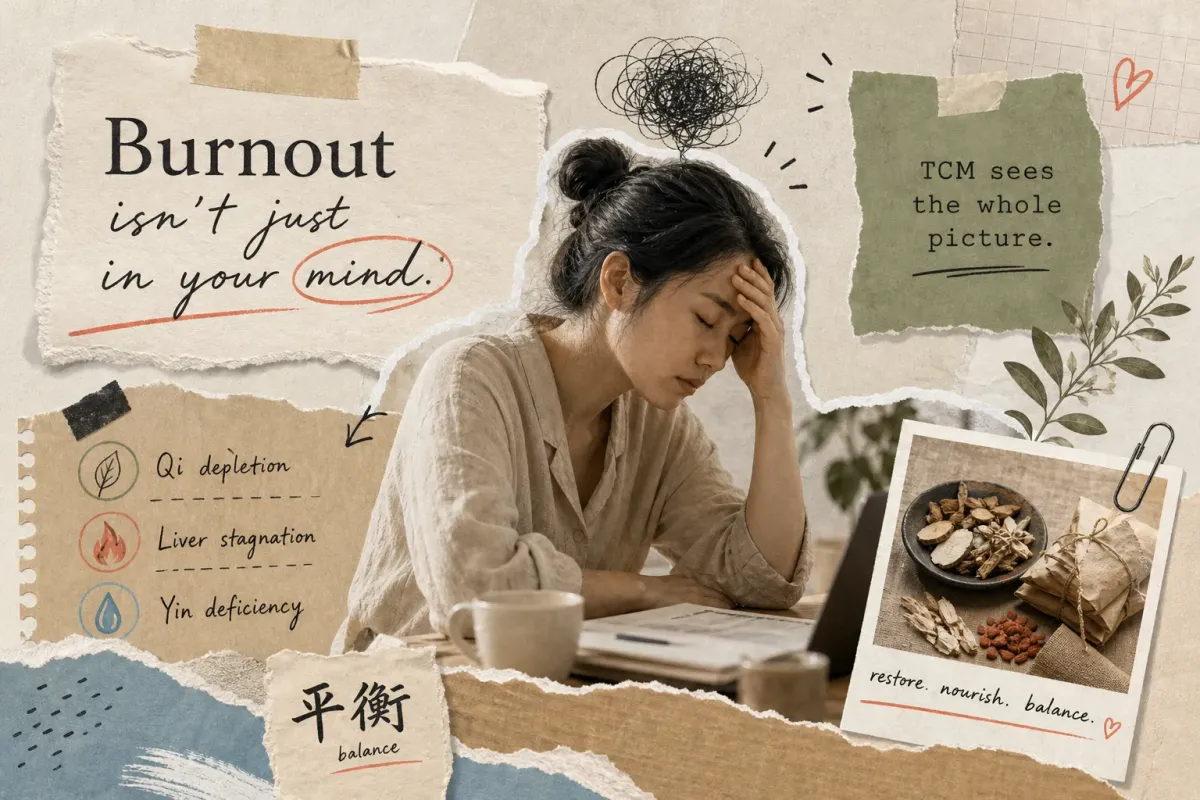
Traditional Chinese Medicine for Burnout: Patterns, Evidence & Safety
What traditional Chinese medicine says about burnout
By Dr. Holly Battrum, DACM, LAc, founder of Sjökort Health & Wellness · Updated November 2026
Traditional Chinese medicine for burnout takes a fundamentally different approach than conventional care: rather than treating exhaustion as a single condition with a single fix, it maps depletion to distinct internal patterns, each requiring its own strategy. Traditional East Asian Medicine (TEAM), of which TCM is the most widely practiced branch in the United States, identifies which organ systems have become depleted or constrained under sustained stress. Your burnout is not the same as your colleague's burnout, and a well-trained TEAM practitioner treats it that way. At Sjökort Health & Wellness, we combine that individualized TEAM lens with modern neuroscience in virtual stress and burnout coaching built around the person in front of us, not a protocol.
This article covers what those patterns are, what the evidence honestly says about acupuncture and herbs, which safety issues matter, and what realistic recovery looks like when you work with a qualified practitioner.
Key takeaways
Pattern diagnosis is central: Traditional Chinese medicine for burnout identifies which organ systems are depleted or constrained, not just that you are exhausted.
Several patterns are most commonly considered: Spleen Qi deficiency, Liver Qi stagnation, Heart-Spleen deficiency, and Kidney Yang or Yin deficiency, often in combination.
Acupuncture shows a signal for fatigue: A 2026 systematic review found meaningful fatigue reduction in chronic fatigue populations, but evidence certainty is low to very low.
Herbs carry real drug interaction risks: Ginseng, licorice root, dang gui, and schisandra all interact with common psychiatric and cardiovascular medications.
TCM works alongside conventional care: Not instead of it, especially when symptoms are severe or persistent.
Track recovery with real measures: Sleep diaries, energy ratings, and validated scales like the PHQ-9 or WHO-5 Well-Being Index give you something to actually assess.
How does traditional Chinese medicine define burnout?
TEAM has no single burnout diagnosis. Instead, practitioners identify which organ systems have become depleted or constrained under sustained stress. The patterns most commonly considered are Spleen Qi deficiency (persistent fatigue, poor concentration, digestive weakness), Liver Qi stagnation (irritability, emotional tension, fluctuating symptoms), Heart-Spleen deficiency (mental exhaustion, insomnia, palpitations, worry), and Kidney deficiency in one of two forms: Yang deficiency, marked by deep cold exhaustion and low drive, or Yin deficiency, the "wired but tired" state featuring night sweats, restlessness, and dry mouth.
Mixed patterns are the rule rather than the exception. Liver Qi stagnation layered over Spleen Qi deficiency is extremely common in high-achieving adults under sustained pressure. So is Heart-Spleen deficiency progressing toward Kidney Yin depletion after years of overwork and inadequate rest.
A TEAM practitioner doesn't rely on symptom lists alone. Tongue color and coating, combined with pulse qualities at specific positions, help confirm which pattern is primary. A pale, swollen tongue with teeth marks suggests Spleen or Qi deficiency. A red, peeled tongue with a rapid thin pulse points toward Kidney Yin depletion. A wiry pulse signals Liver Qi constraint. These findings require clinical training to interpret accurately, which is exactly why self-diagnosing from a wellness article misses the mark.
What the five spirits reveal about deep exhaustion
Where TEAM diverges most sharply from conventional medicine is in its framework of the five spirits, the Wu Shen. Each spirit resides in a specific organ system and governs a distinct dimension of mental and emotional life. Chronic overwork doesn't just deplete the body; in TEAM thinking, it depletes the spirits housed within it.
The Kidney system governs what is called Jing, or essence: the deepest constitutional reserve of vitality. When prolonged overwork, poor sleep, or chronic stress drains Kidney Jing, the result looks strikingly similar to what Western integrative medicine sometimes calls adrenal fatigue (a popular label, though not a recognized medical diagnosis): profound exhaustion, reduced resilience, poor stress tolerance, and a body that stops bouncing back. The spirit housed in the Kidney is Zhi, the will. Clients often describe its depletion not as laziness but as a frightening loss of the internal drive they once relied on.
The Heart houses Shen, which governs consciousness, presence, and emotional stability. The Spleen houses Yi, the intellect responsible for concentration and intentional thought. When burnout is rooted in Heart-Spleen deficiency, as it often is for people who spend years thinking and caring for others without adequate restoration, the result is mental fatigue that sleep doesn't fully fix, a scattered quality of attention, and a hollow emotional flatness. These presentations don't respond well to the same herbs prescribed for Kidney depletion. Accurate pattern differentiation matters precisely because the treatment that helps one pattern can be irrelevant, or even counterproductive, for another.
Does the evidence support traditional Chinese medicine for burnout?
The honest answer is: somewhat, with important caveats. The evidence base is more developed for chronic fatigue conditions than for occupational burnout specifically, and certainty is rated low to very low across the literature. A 2026 systematic review in Frontiers in Neurology (Li et al.) of eight randomized trials involving 715 patients with chronic fatigue syndrome found a pooled reduction in fatigue (SMD = -1.31). Heterogeneity was very high (I² = 91.7%) and the authors rated the certainty as limited. Warm needling and moxibustion showed the largest subgroup effects. Acupuncture shows a meaningful signal for fatigue relief, but it has not been validated in burnout populations using rigorous burnout-specific outcomes.
Herbal formulas in traditional Chinese medicine for burnout
Formula selection follows the pattern diagnosis. For Qi and Blood deficiency, formulas like Gui Pi Tang or Ren Shen Yang Rong Tang are common choices. For Liver Qi stagnation layered over deficiency, Xiao Yao San or its modified version is frequently used. Adaptogenic single herbs like Huang Qi (astragalus) and Ren Shen (ginseng) address Qi deficiency, while Wu Wei Zi (schisandra) is often added for fatigue complicated by poor sleep or spontaneous sweating. Evidence for ginseng in disease-related fatigue shows a small benefit (SMD approximately 0.33 across twelve RCTs), according to a 2022 meta-analysis in the journal Medicine, but results in chronic fatigue populations are inconsistent. Most herbs work best within the context of a properly matched formula, not taken in isolation.
What safety issues matter before starting TCM herbs?
TCM herbs are not uniformly safe, and "natural" does not mean risk-free. Several commonly used herbs carry real interaction and contraindication concerns that both practitioners and patients need to understand before starting treatment.
Ginseng can interact with antidepressants, blood pressure medications, and warfarin; it has also been associated with manic symptoms and insomnia in susceptible individuals, including a reported interaction with the MAOI phenelzine, according to research cited by NCCIH. Licorice root (Gan Cao), present in many formulas, raises blood pressure and lowers potassium, a clinically important concern for anyone on diuretics, digoxin, or corticosteroids. Dang gui and Dan shen both carry antiplatelet effects and can potentiate anticoagulants significantly.
Schisandra alters CYP enzyme pathways, affecting the metabolism of drugs including tacrolimus, some statins, and anticonvulsants. The complexity multiplies with multi-herb formulas, where interactions are harder to predict. Anyone taking warfarin or other anticoagulants, immunosuppressants, psychiatric medications, or blood pressure drugs should review their full medication list with a qualified TEAM practitioner and their prescribing physician, and consider a pharmacist consultation, before starting herbs.
Pregnancy is a separate category: most concentrated TCM extracts lack adequate safety data in pregnancy, and several herbs are specifically contraindicated, including blood-moving herbs like Chuan Xiong, Tao Ren, and Hong Hua. If persistent fatigue is severe or has lasted more than a few weeks, a medical evaluation to rule out anemia, thyroid disease, sleep apnea, or depression should happen before or alongside TCM care, not instead of it.
What a real TEAM burnout recovery program looks like
A TEAM approach to burnout isn't a standard protocol applied to everyone who walks through the door. It's a map built around the individual, their pattern presentation, lifestyle, constitution, and goals. Through Stress and Burnout Coaching: Integrated Health Coaching, Dr. Holly Battrum, DACM, LAc, builds individualized programs, delivered virtually, that integrate authentic TEAM frameworks with modern neuroscience, including nervous system regulation work such as vagus nerve toning and interoceptive awareness practices that help clients rebuild their body's self-regulation signals.
Effective recovery tracking means measuring real outcomes. Keep a sleep log that records time to fall asleep, number of awakenings, and how restored you feel each morning. Energy ratings from 0 to 10 at morning and afternoon, noted against functional capacity, reveal patterns that a general sense of "feeling better" can obscure. Validated tools like the PHQ-9, GAD-7, or WHO-5 Well-Being Index provide a meaningful baseline and a way to assess genuine progress. Look for sustained improvement across two to four weeks, not session-by-session fluctuation. Most practitioners formally reassess at weeks four to eight. Continuing past twelve weeks without measurable improvement warrants a reassessment of the diagnosis, not a reflex to add more treatment.
TEAM works best as part of an integrated approach. If low mood, hopelessness, loss of interest, or sleep disruption has persisted more than two weeks; if symptoms are interfering with work or relationships; or if rest is no longer restorative, a primary-care or mental-health evaluation should happen promptly. For thoughts of self-harm, chest pain, fainting, or sudden neurologic changes, emergency care comes first, always. In the US, call or text 988 to reach the Suicide & Crisis Lifeline, or call 911.
Where to start with traditional Chinese medicine for burnout
Traditional Chinese medicine for burnout offers something conventional medicine often skips: a framework for understanding which part of you is depleted, not just that you are. The five spirits, the pattern diagnoses, the carefully matched herbs and acupuncture points are all in service of one question, what does this particular person need to restore their particular version of vitality?
Recovery from burnout rarely looks like aggressive intervention. It usually looks like slowing down enough to actually hear what your body has been trying to tell you. A skilled TEAM practitioner helps you hear it more clearly, and then builds a program around what you hear.
If you're ready to understand your pattern and build a recovery plan that fits you specifically, start with a single Stress and Burnout Coaching session with Dr. Holly Battrum. Sessions are fully virtual, so you can work with us from anywhere, and there is no package to buy up front. Not sure where you are yet? Take the two-minute micro-break quiz first.
Frequently Asked Questions
Can I keep taking my psychiatric or cardiovascular medications while starting TCM herbs or acupuncture?
You can, but you must review your full medication list with a qualified TEAM practitioner and your prescribing physician first. Some commonly used herbs in TCM, ginseng, licorice root, dang gui, schisandra, carry real interaction risks with antidepressants, anticoagulants, blood-pressure drugs, immunosuppressants, and other medications, so a coordinated review and, if needed, a pharmacist consultation are important before starting herbs.
Can traditional Chinese medicine replace my regular medical or psychiatric care for burnout?
No, traditional Chinese medicine is meant to work alongside conventional care rather than replace it. We advise that severe or persistent symptoms get a primary-care or mental-health evaluation, and emergency care is always appropriate for thoughts of self-harm, chest pain, fainting, or sudden neurologic changes.
How concerned should I be about herb–drug interactions if I take medications?
You should be very cautious because several commonly used TCM herbs have real interaction risks with psychiatric, cardiovascular, and other medications. We recommend reviewing your full medication list with a qualified TEAM practitioner and your prescribing physician, and considering a pharmacist consultation, before starting herbs, since herbs like ginseng, licorice, dang gui, and schisandra can affect blood pressure, clotting, or drug metabolism.
Is acupuncture likely to reduce my fatigue from burnout?
Acupuncture shows a meaningful signal for fatigue in chronic fatigue populations, but evidence certainty is low and it has not been validated specifically for occupational burnout with rigorous burnout outcomes. We view acupuncture as a potentially helpful component of care, especially given subgroup signals for warm needling and moxibustion, but it should be considered alongside other measures and clinical evaluation.
How do practitioners determine which TEAM pattern matches my burnout?
Practitioners use a combination of symptom patterns and specific physical signs such as tongue appearance and pulse qualities to differentiate patterns. We note that a pale, swollen tongue with teeth marks points toward Spleen or Qi deficiency, a red peeled tongue with a rapid thin pulse suggests Kidney Yin depletion, and a wiry pulse indicates Liver Qi constraint, findings that require clinical training to interpret accurately.
Can I work with a TEAM practitioner for burnout virtually?
Yes, for most of the work. Pattern assessment through a detailed intake and conversation, nervous system regulation practices, sleep and energy tracking, lifestyle and rhythm changes, and coordination with your other providers all work well over video. Acupuncture and pulse reading require an in-person visit, so a virtual program focuses on the parts of TEAM that you can practice on your own between sessions. Stress and Burnout Coaching at Sjökort Health & Wellness is delivered virtually.
Sources
Li Y, Liang G, Xiao T, Xu L. Efficacy of acupuncture-based traditional Chinese medicine therapies for chronic fatigue syndrome: a systematic review and meta-analysis. Frontiers in Neurology, 2026.
Zhu J, et al. Efficacy of ginseng supplements on disease-related fatigue: a systematic review and meta-analysis. Medicine, 2022.
National Center for Complementary and Integrative Health. Herb-Drug Interactions: What the Science Says.
StatPearls. Ginseng. NCBI Bookshelf.


